Introduction
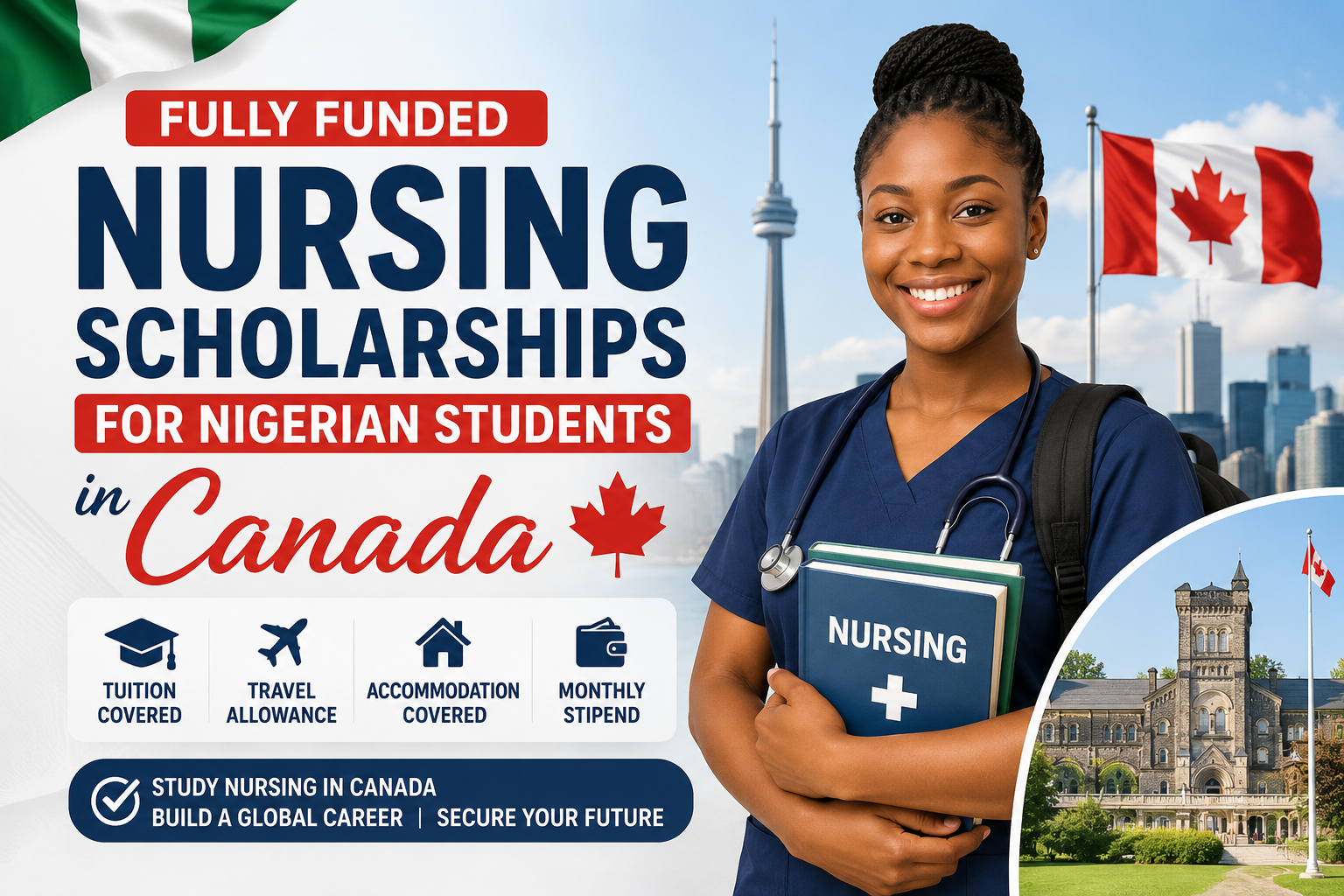
Want to study nursing in Canada but worried about the cost? Nursing Scholarships in Canada can help Nigerian students make a Canadian nursing education more affordable.
With international nursing tuition averaging C$30,668 per year for 2026/2027, finding the right funding can make a significant difference. In this guide, you’ll discover Nursing Scholarships in Canada, eligibility requirements, application tips, study costs, proof-of-funds requirements, and what Nigerian students need to know before applying.
Why Study Nursing in Canada?
Canada is an attractive destination for students interested in nursing because of its established healthcare education system and practical approach to professional training.
1. High-Quality Nursing Education
Canadian nursing programs combine academic study with practical and clinical learning.
Depending on the program, students may study subjects such as patient assessment, pharmacology, community health, nursing practice, healthcare research, and professional ethics.
Clinical education is an important component of nursing training because students need practical experience before entering professional practice.
2. Practical Clinical Training
Nursing students can receive supervised clinical experience in healthcare environments such as hospitals, clinics, community settings, and other healthcare facilities.
This allows students to apply classroom knowledge to real patient-care situations.
3. International Learning Environment
Canadian universities attract students from many countries, giving Nigerian students an opportunity to study in multicultural academic environments and interact with people from different backgrounds.
4. Opportunities After Graduation
Graduating from a Canadian nursing program does not automatically make someone eligible to practise as a nurse.
Nursing is a regulated profession, and graduates must satisfy the requirements of the nursing regulatory authority in the province or territory where they intend to practise.
Students should therefore consider both the university’s admission requirements and the relevant nursing regulator’s requirements before choosing a program.
How Much Does It Cost to Study Nursing in Canada?
Cost is one of the most important issues Nigerian students should consider before applying.
Statistics Canada’s preliminary 2026/2027 figures put average international undergraduate nursing tuition at C$30,668 per year across Canada. This is a national average, so individual universities can charge considerably more or less.
Students should also budget for:
- Accommodation
- Food and groceries
- Transportation
- Health insurance
- Books and supplies
- Phone and internet
- Personal expenses
- Winter clothing and other seasonal expenses
- Travel between Nigeria and Canada
- Study permit-related costs
Students should check the exact tuition and mandatory fees published by their chosen university before applying.
Example of a First-Year Budget
| Expense | Approximate amount |
|---|---|
| Average nursing tuition | C$30,668 |
| Living-cost budget | C$23,000+ |
| Tuition + living costs | C$53,668+ |
| Travel and other expenses | Additional |
This is an illustration based on national averages and should not be treated as the exact cost of studying at every Canadian university.
Are There Fully Funded Nursing Scholarships in Canada for Nigerian Students?
Yes, funding opportunities exist, but students should understand what “fully funded” means before applying.
There is no single Canadian government scholarship that automatically pays the complete cost of a four-year undergraduate nursing degree for every Nigerian student.
Funding can instead come from several sources.
Full or Major Funding
These scholarships may cover some combination of:
- Tuition
- Accommodation
- Living expenses
- Books
- Travel
- Health insurance
Partial Scholarships
These provide a fixed amount or reduce part of the student’s tuition.
University Entrance Awards
These are scholarships offered by universities to new students based on factors such as academic achievement, financial need, leadership, or other criteria.
In-Course Nursing Awards
These are generally available after a student has started studying nursing.
This distinction is important because some Nursing Scholarships in Canada are only available to students already enrolled at a Canadian institution.
Nursing Scholarships in Canada for Nigerian Students: Verified Funding Routes
Nigerian applicants should focus on scholarships whose eligibility and application procedures can be confirmed directly through the university, government department, foundation, or other official provider.
1. University Scholarships and Nursing Awards
Canadian universities provide scholarships through their central scholarship offices and nursing faculties.
The University of Alberta’s Faculty of Nursing, for example, lists nursing awards for undergraduate students. These include awards based on academic standing, financial need, leadership, and other criteria.
The faculty also lists international nursing-related awards, although applicants must check the specific eligibility requirements for each award.
Nigerian students should therefore search both:
- The university’s main scholarship database
- The Faculty of Nursing’s scholarship and awards page
2. University of Toronto Nursing Awards
The Lawrence Bloomberg Faculty of Nursing at the University of Toronto provides awards and scholarships for students enrolled in its nursing programs.
Its financial-support information includes undergraduate nursing awards, including admission and in-course awards.
Some awards are based on financial need, while others consider academic achievement or other criteria.
International students should carefully check the eligibility conditions of each award before applying.
3. General University Scholarships
Not every useful scholarship is specifically called a nursing scholarship.
Some Canadian universities offer major scholarships for international undergraduate students that can support students in different academic programs.
For example, the Lester B. Pearson International Scholarship at the University of Toronto provides substantial support to selected international undergraduate students, including tuition, books, incidental fees, and residence support.
Students interested in this type of award should confirm that their intended nursing program and admission route qualify.
Government of Canada Scholarships: An Important Difference
One important point Nigerian students should understand is that Government of Canada scholarships are not all designed to fund a complete undergraduate or master’s degree.
The Study in Canada Scholarships (SICS) program, for example, supports short-term study or research exchanges rather than a typical four-year undergraduate nursing degree.
Nigeria is among the eligible countries for the program, but individual students do not simply submit a direct application for a full degree scholarship.
Canadian post-secondary institutions apply and select eligible participants for the program.
Therefore, Nigerian students should not treat Study in Canada Scholarships as equivalent to a fully funded four-year BScN scholarship.
Where to Find Nursing Scholarships in Canada
Nigerian students can search for Nursing Scholarships in Canada through:
- Official university scholarship pages
- Nursing faculty websites
- EduCanada
- Canadian government scholarship announcements
- Provincial scholarship programs
- Recognized nursing organizations
- Foundations and charitable organizations
- Institutional partnerships
Nigerian students can also use the official EduCanada Scholarship Search to find scholarship opportunities and filter available funding according to their citizenship and student profile.
A scholarship listed on a third-party website should be verified on the website of the organization that actually provides the funding.
Eligibility Requirements for Nursing Scholarships
Requirements vary by scholarship, but Nigerian applicants may encounter the following criteria.
Academic Performance
Many scholarships consider academic achievement.
Competitive university awards may require strong academic results.
Admission to a Canadian Institution
Some scholarships require an admission offer before funding can be awarded.
Others automatically consider students for scholarships during the admission process.
English-Language Requirements
A nursing program may have English-language requirements even when the scholarship itself does not.
Students should check the exact requirements of their chosen university.
Personal Statement
Where required, the statement should explain the student’s academic background, motivation for nursing, career goals, achievements, and relevant experiences.
Leadership and Community Involvement
Some scholarships consider leadership, volunteering, community service, or extracurricular activities.
Financial Need
Need-based scholarships may require evidence demonstrating financial circumstances.
References
Some scholarships require recommendation letters from teachers, lecturers, employers, or other qualified referees.
Can Nigerian Students Study Nursing in Canada Without Already Being Nurses?
Yes, but the pathway depends on your educational background.
If You Are a Secondary School Graduate
You can apply for an undergraduate nursing program if you meet the university’s admission requirements.
If You Already Have a Bachelor’s Degree
Some Canadian universities offer second-entry or accelerated nursing programs for applicants who have completed previous university studies.
If You Are Already a Nurse in Nigeria
Your pathway is different.
You may not need to start another undergraduate nursing degree. Instead, you may need to investigate the Canadian internationally educated nurse registration process.
Nursing Scholarships vs. Canadian Nursing Licensure
Getting a scholarship to study nursing and getting permission to practise nursing in Canada are two separate processes.
A scholarship helps finance education.
A nursing regulator determines whether you meet the requirements to practise as a nurse.
For internationally educated nurses, the National Nursing Assessment Service (NNAS) is the starting point for many applicants seeking registration in Canada.
NNAS does not issue the nursing licence. The relevant provincial or territorial nursing regulatory body makes the registration decision.
The general pathway can therefore look like:
Nigerian nursing qualification → Required assessment process → Provincial nursing regulator → Registration/licensure
Requirements can vary by province or territory.
Do You Need a Study Permit to Study Nursing in Canada?
If your nursing program is longer than six months, you will generally need a Canadian study permit.
You must first receive a letter of acceptance from a Designated Learning Institution (DLI).
Canada maintains an official DLI list that students can use to verify whether an institution qualifies under the study-permit system.
IRCC explains the acceptable forms of financial evidence and the amount students must demonstrate for tuition, living expenses and transportation: Canada study permit: Proof of financial support
Students should check the official DLI list instead of relying solely on claims from an education agent.
Do Nigerian Students Need a PAL or TAL?
A Provincial Attestation Letter (PAL) or Territorial Attestation Letter (TAL) is required for many study permit applications, although specific exemptions apply.
From January 1, 2026, eligible students entering master’s or doctoral degree programs at public DLIs generally do not need a PAL/TAL.
This exemption does not automatically apply to undergraduate nursing applicants.
Nigerian students applying for bachelor’s-level nursing programs should check the current IRCC requirements and follow the instructions provided by their institution.
Do You Still Need Proof of Funds If You Receive a Scholarship?
Yes, potentially.
Receiving a scholarship does not automatically remove Canada’s financial requirements for a study permit.
Applicants generally need to demonstrate that they can pay for:
- Tuition
- Living expenses
- Transportation to and from Canada
A scholarship can form part of the financial evidence if it covers eligible expenses.
If a scholarship covers only part of your tuition, you must demonstrate how you will pay the remaining tuition and living costs.
This is why students should calculate their remaining financial requirement after receiving a scholarship rather than assuming that any scholarship makes them financially qualified.
What Documents Do Nigerian Students Need?
Requirements vary by university and scholarship, but applicants may need:
- International passport
- Academic certificates
- Academic transcripts
- WAEC/NECO results where applicable
- Admission application documents
- Letter of acceptance, where required
- Personal statement
- Scholarship essay
- Recommendation letters
- CV or résumé
- Proof of English proficiency where required
- Evidence of leadership or community involvement
- Financial documents for need-based scholarships
- Scholarship-specific forms
Always check the exact document requirements before submitting an application.
How to Apply for Nursing Scholarships in Canada
Step 1: Choose Your Nursing Pathway
Determine whether you are applying for:
- Bachelor of Science in Nursing
- Second-entry or accelerated nursing
- Master’s nursing program
- Nursing research program
- Another healthcare-related program
Step 2: Find Eligible Canadian Universities
Check:
- Program availability
- International admission eligibility
- Tuition
- English-language requirements
- Application deadlines
- Clinical requirements
- Scholarship opportunities
Step 3: Apply for Admission
Some scholarships require you to receive admission before applying.
Others automatically assess applicants for entrance awards.
Do not assume that applying for admission automatically means you have applied for every scholarship.
Step 4: Search for Scholarships
Check the university’s scholarship database, nursing faculty funding pages, and official Canadian scholarship resources.
Step 5: Prepare Your Application
Prepare your:
- Personal statement
- CV/resumé
- Academic transcripts
- Recommendation letters
- Scholarship essays
- Other required documents
Step 6: Submit Before the Deadline
Keep separate deadlines for:
- University admission
- Scholarship applications
- Supporting documents
- Recommendation letters
- Study permit
- PAL/TAL where applicable
Step 7: Prepare Your Study Permit Application
After receiving admission and funding decisions, prepare the required study permit documents, including financial evidence and any required PAL/TAL.
2026/2027 Nursing Scholarship Application Timeline
There is no single deadline for all Nursing Scholarships in Canada because universities and organizations use different application schedules.
A practical planning timeline is:
| Period | What to Do |
|---|---|
| 12–18 months before study | Research nursing programs and scholarships |
| 9–15 months before study | Check admission requirements and prepare documents |
| 8–12 months before study | Submit university applications where deadlines open |
| 6–12 months before study | Apply for scholarships with separate applications |
| After admission | Confirm tuition, scholarship value, and remaining funding |
| After required documents are available | Prepare study permit application |
| Before travel | Arrange accommodation, insurance, transportation, and finances |
Always follow the actual deadline published by the university or scholarship provider.
Scholarships for Undergraduate vs. Graduate Nursing Students
Funding opportunities can differ according to study level.
Undergraduate Nursing Students
Undergraduate applicants should investigate:
- International entrance scholarships
- University-wide scholarships
- Faculty of Nursing awards
- Need-based awards
- Merit scholarships
- External scholarships
Master’s Nursing Students
Graduate applicants should investigate:
- University graduate scholarships
- Research funding
- Graduate assistantships
- Faculty awards
- External fellowships
- Supervisor-supported funding where applicable
Doctoral Nursing Students
PhD applicants can investigate:
- University doctoral scholarships
- Research grants
- Supervisor-supported funding
- Teaching assistantships
- Research assistantships
- External fellowships
Common Mistakes Nigerian Students Should Avoid
1. Assuming Every Nursing Scholarship Is Fully Funded
A scholarship may cover only tuition, part of tuition, or provide a fixed amount.
Always check exactly what the scholarship pays for.
2. Applying Without Checking International Eligibility
Some Canadian nursing awards are restricted to Canadian citizens or permanent residents.
3. Confusing Exchange Scholarships With Degree Scholarships
Short-term Canadian government scholarship programs should not automatically be treated as funding for a full undergraduate nursing degree.
4. Ignoring Costs After Receiving a Scholarship
A C$5,000 scholarship can be valuable, but it does not necessarily make a C$30,000+ tuition bill fully funded.
Calculate your remaining expenses.
5. Choosing a School Without Checking Its DLI Status
Verify your institution through Canada’s official DLI list.
6. Assuming Admission Means Nursing Licensure
Graduating from a Canadian nursing program does not by itself complete the professional licensing process.
7. Waiting Until the Last Minute
Scholarship applications may require transcripts, references, essays, and other documents that take time to prepare.
How to Avoid Nursing Scholarship Scams
Nigerian students should be cautious about websites, social-media accounts, agents, or individuals promising guaranteed Canadian scholarships.
Be especially careful if someone:
- Guarantees a scholarship
- Requests a large payment to “secure” funding
- Promises admission without a formal application
- Claims to have insider access to a university
- Asks you to transfer money to a personal account
- Provides a scholarship letter that cannot be verified
Always verify the scholarship directly through the university, Canadian government department, foundation, or organization that supposedly provides it.
How to Improve Your Scholarship Application
Maintain Strong Academic Results
Academic performance is an important consideration for many university awards.
Explain Why Nursing Matters to You
Your personal statement should connect your education, experiences, motivation, and career objectives.
Demonstrate Leadership and Community Involvement
Healthcare volunteering, community projects, leadership positions, and relevant professional experience can strengthen an application where these factors are considered.
Explain Financial Need Where Required
For need-based scholarships, provide honest information and the financial evidence requested.
Apply for Multiple Opportunities
Do not depend on one scholarship.
Investigate university entrance awards, nursing faculty awards, and external funding opportunities where you meet the eligibility requirements.
Frequently Asked Questions About Nursing Scholarships in Canada
Can Nigerian students apply for Nursing Scholarships in Canada?
Yes. Nigerian students can apply for scholarships and awards where the published eligibility requirements include international students or applicants from Nigeria.
However, many Canadian nursing awards are restricted to Canadian citizens or permanent residents, so eligibility must be checked individually.
Are there fully funded Nursing Scholarships in Canada?
Fully funded opportunities exist in Canadian education, but there is no single universal fully funded nursing scholarship available to every Nigerian applicant.
Many awards provide partial rather than complete funding.
How much does nursing cost in Canada for international students?
Statistics Canada’s preliminary 2026/2027 national average for international undergraduate nursing tuition is C$30,668 per year.
Individual institutions may charge different amounts.
How much money do I need for living expenses?
Students should budget for accommodation, food, transportation, health insurance, books, personal expenses, and other costs in addition to tuition.
Do I need proof of funds if I receive a scholarship?
Yes, potentially.
If the scholarship does not cover all of your tuition and living expenses, you must demonstrate how the remaining costs will be paid.
Can I apply for several nursing scholarships?
Yes, provided the individual scholarship rules allow it.
Applying for several suitable opportunities can reduce your dependence on one funding source.
Do Nigerian-trained nurses need NNAS?
NNAS is the starting point for internationally educated nurses seeking registration in many Canadian jurisdictions.
However, NNAS does not issue a nursing licence. The relevant provincial or territorial regulator makes the registration decision.
Can I study nursing in Canada without being a nurse in Nigeria?
Yes.
Students can apply for Canadian undergraduate nursing programs if they meet the institution’s admission requirements.
Existing Nigerian nurses may instead need to investigate the internationally educated nurse registration pathway.
Do undergraduate nursing students need a PAL/TAL?
Many undergraduate study permit applicants require a PAL/TAL, although specific exemptions exist.
The 2026 exemption for eligible master’s and doctoral students at public DLIs does not automatically apply to undergraduate nursing applicants.
Can a scholarship pay for accommodation?
It depends on the scholarship.
Some awards are tuition-only, while others may include residence or living expenses.
When should I start applying?
Start researching well before your intended intake.
Beginning early gives you time to compare programs, prepare documents, find scholarships, obtain references, and meet separate university and scholarship deadlines.
Conclusion
Studying nursing in Canada can be expensive, but the right scholarship can significantly reduce the financial burden.
Nigerian students should compare Nursing Scholarships in Canada carefully, verify eligibility through official sources, and plan for tuition, living costs, study-permit requirements, and nursing registration.
With early preparation and careful research, you can identify funding opportunities that fit your nursing program and financial situation.